
LTE & GNSS tracker reference design
A battery tracker that reports to the client’s own MQTT broker, with firmware the client owns and a module plan that survives US supply-chain rules. Built on our bench to shorten your first prototype.
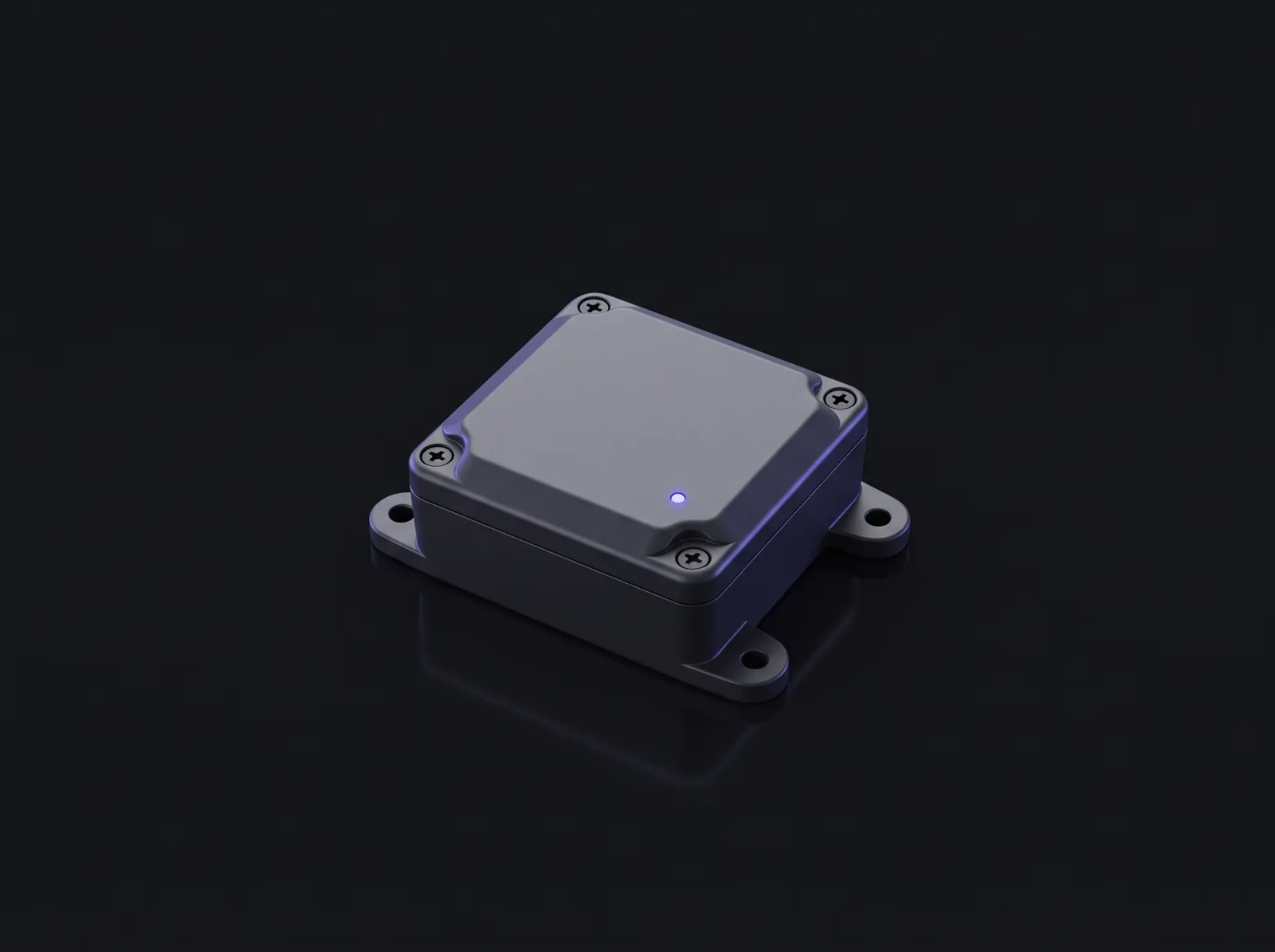 Concept render
The challenge
Companies that want a custom tracker usually already have software: a fleet, logistics or field-safety platform. White-label trackers tend to cause the same problems.
- The device speaks the vendor’s private protocol and reports to the vendor’s server first.
- Firmware changes need the vendor’s queue and the vendor’s price.
- The module inside is unknown, or comes from a supplier the client’s own customers now ask about.
- US band coverage is incomplete. Some models still lean on 2G or 3G fallback that no longer exists in the US.
We built this reference design to answer one question: what is the smallest tracker we can hand a client where the protocol, the cloud endpoint, the keys and the source are all theirs?
Constraints
| Constraint | Target | Why |
|---|---|---|
| Radio | LTE Cat-1bis or LTE-M, no 2G / 3G fallback | As of October 2026, all three US carriers have shut down 2G and 3G. AT&T has stopped certifying new NB-IoT devices, so NB-IoT is not the primary path. |
| US bands | B2, B4, B5, B12, B13, B66, B71 | Covers AT&T, Verizon and T-Mobile low and mid bands, including B13 (Verizon) and B71 (T-Mobile). |
| Positioning | GNSS (GPS + one more constellation), Wi-Fi scan as fallback | Indoor and urban-canyon fixes without leaving GNSS on. |
| Battery life | [Target days at N reports per day — to fill] | Depends on report interval, PSM / eDRX support on the client’s carrier, and fix strategy. |
| Cloud | MQTT over TLS 1.2+ to the client’s broker | No Duobay or vendor server in the data path. |
| Sourcing | Two pin-compatible BOM variants | Since December 26, 2025, the FCC Covered List rules also reach modules inside end devices (FCC 25-71). A second, non-China module variant keeps the design shippable if rules tighten. |
| Certification | FCC, PTCRB, carrier, planned at Gate 0 | A modular grant does not cover the whole product. See below. |
Architecture
Part numbers below are example families we evaluate. Final parts are chosen per client at Gate 0, against that client’s carrier, volume and sourcing rules.
| Block | Example part family | Notes |
|---|---|---|
| Cellular, variant A | Cat-1bis module, widely used in Shenzhen designs [to confirm] | Lower unit cost. Check against the current FCC Covered List before each build. |
| Cellular, variant B | Non-China LTE-M / Cat-1bis module, e.g. Nordic nRF91-series, u-blox, Telit Cinterion or Sierra families [to confirm] | For clients whose buyers ask for non-China radios. Price, MOQ and lead time per variant [to confirm]. |
| GNSS | Integrated in the module, or a discrete multi-constellation receiver [to confirm] | Shared or separate antenna decided by enclosure size. |
| Host MCU | Low-power Cortex-M class MCU, or the module’s own application core [to confirm] | Running the application on the module saves a chip. A separate MCU makes a module swap easier. |
| Sensors | 3-axis accelerometer with wake-on-motion [to confirm] | Motion wakes the radio. Optional temperature or shock sensing. |
| Short range | BLE for setup and beacon scanning [to confirm] | Lets a phone provision the device without a cloud account. |
| Power | Li-ion or Li-SOCl₂ primary cell, fuel gauge, USB-C charging on the rechargeable build [to confirm] | UN38.3 test summary needed to ship. |
| SIM | Nano-SIM and MFF2 eSIM footprint | The client chooses the carrier or MVNO. We do not resell connectivity. |
Firmware
- Reports as JSON or CBOR over MQTT. The topic and payload schema are documented and belong to the client.
- Per-device X.509 certificates. The client holds the CA and the signing keys. Duobay keeps no copy after handover.
- Signed OTA images with rollback. The client’s backend triggers updates.
- Configurable report interval, motion-triggered reports, geofence and low-battery events.
- SBOM in SPDX or CycloneDX format, generated at every release.
Certification plan
A pre-certified module helps, but the finished tracker still needs work in its own name. As of October 2026:
- FCC. If the integration follows the module grant’s conditions, the module’s FCC ID carries over and the host needs Part 15 Subpart B testing. A body-worn build within 20 cm of the user usually falls outside a mobile-only module grant and needs RF exposure work. Guidance: FCC KDB 996369, searchable in the FCC Knowledge Database. Our FCC modular checklist lists the conditions.
- PTCRB. Needed for AT&T and T-Mobile, even with a PTCRB-certified module. See PTCRB: get certified.
- Verizon. Its own device certification process. The finished device must pass it.
- Test labs. Formal testing runs at an FCC-recognized lab outside mainland China, priced into Gate 3.
Lab and certification fees are paid by the client. We manage the process and the grants are issued in the client’s name. How we handle certification.
Building a tracker? Start from this design and spend Gate 1 on your use case instead of on module bring-up. Start from this design →
Gate timeline
Typical durations come from our standard gates. What this design covered at each gate is listed next to it. Status is filled in as the design moves.
| Gate | Typical duration | Scope in this design | Status |
|---|---|---|---|
| Gate 0 · Feasibility | 1–2 weeks | Requirements, US band list, module shortlist with two sourcing variants, power budget, HTS classification question, FCC / PTCRB / carrier plan. | [Done / in progress / not started — to fill] |
| Gate 1 · Works-like prototype | 3–6 weeks | Module evaluation boards on a custom carrier. First firmware: GNSS fix, LTE attach, MQTT over TLS to a test broker, PSM / eDRX current measured. | [Done / in progress / not started — to fill] |
| Gate 2 · EVT · first custom PCB | 6–10 weeks | Custom 4-layer board, antenna matching, first enclosure, OTA with signed images, provisioning flow, EVT test report. | [Done / in progress / not started — to fill] |
| Gate 3 · DVT / PVT · small batch | 8–16 weeks | IP-rated enclosure, drop and temperature tests, RF pre-scan, formal FCC and carrier certification in the client’s name, production test fixture. | [Done / in progress / not started — to fill] |
| Gate 4 · Mass production | Ongoing | Not applicable to a reference design. A client version enters Gate 4 under its own contract. | — |
Results
We publish measured numbers only. Until the bench data is ready, these stay blank.
| Measurement | Result | Conditions |
|---|---|---|
| Sleep current (PSM) | [µA — to fill] | [Carrier, network timer values — to fill] |
| Energy per report | [mJ or µAh — to fill] | [Fix type, payload size, RSRP — to fill] |
| Estimated battery life | [Days — to fill] | [Reports per day, cell capacity — to fill] |
| GNSS time to first fix | [Cold / hot, seconds — to fill] | [Open sky, assisted or not — to fill] |
| Bands verified | [List — to fill] | [Network or call-box test — to fill] |
| RF pre-scan | [Pass / margin dB — to fill] | [Lab, standard — to fill] |
Related
Custom LTE & GNSS trackers
Read →FCCCan I use a pre-certified LTE module and skip FCC certification?
Read →Reference designVoice-capture badge
Read →Next step
Tell us what your tracker must do, how many units you need and when. We will tell you which parts of this design carry over and what Gate 0 would cost. A Duobay engineer replies within 2 business days.